Postagens

Dois goleiros, duas mulheres, duas histórias

Imagem
No domingo, dia 11 de junho, dois goleiros ocuparam as manchetes dos jornais de todo o mundo. Um dos motivos: duas belas mulheres. As coincidências param por aí. O primeiro goleiro (ou ex-goleiro) é o brasileiro Bruno, pelo envolvimento no brutal assassinato de uma jovem mãe, de um filho seu fora do casamento. Ela, Eliza Samudio, uma morena de beleza brejeira, sensual, como tantas brasileiras. Ocupação: modelo. Modelo de quê? Fotográfica? De moda? De artes plásticas? Modelo é uma palavra que pode assumir muitos significados, dependendo daquilo que a mulher (ou homem) expõe de sua imagem, de sua vida, de seu comportamento. O fato é que Bruno, um goleiro muito talentoso, por vezes instável – parece que agora dá pra entender por que – é acusado de um crime hediondo, um assassinato recheado com seqüestro, tortura, espancamento, estrangulamento, esquartejamento, aniquilamento, desaparecimento, tudo isso praticado contra a mãe de um recém-nascido. Uma pessoa com quem se envolveu – co...

Brazil July 2010 (4)

Imagem
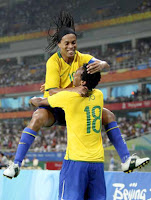
FOOTBALL / SOCCER Late playwright and journalist Nelson Rodrigues once wrote, “Seleção [the 23-player national squad] is our homeland in soccer boots.” That’s the mood in the eve of a new World Cup, this time in South Africa. In recent years Brazil has produced stars in Olympic sports as volleyball, swimming and tennis. But soccer remains unbeatable as no.1. Brazil sees himself as The Soccer Country. Each Brazilian is said to be a soccer coach, what totals 180 million in this country. Brazilians are not so optimistic this time as to winning a sixth World Cup this year. Coach Carlos Dunga chose 23 players not as ball artists, but as loyal workers. Beautiful game is not the main concern. So, big-name veterans as Ronaldo, Ronaldinho (left, on top) and Adriano were left behind when the final list was delivered. So were young stars as Neymar and Ganso, both aged under 20, seen as too young. Dunga (Portuguese for Snow White dwarf Dopey) is famous for his stubbornness and for ill ...

Brazil July 2010 (3)

Imagem
Presbyterian churches in Brazil are divided in two larger branches, and some minor ones. The first Presbyterian missionary to come to Brazil was Ashbell Green Simonton. A Princeton alumnus, he arrived in Rio de Janeiro in August 12, 1859. In a few years he founded churches in Rio, São Paulo and Campinas, organizing a presbytery. He and his wife died still young, of tropical diseases that plagued the country. Mainstream Igreja Presbiteriana do Brasil (founded 1859) has over 3,200 churches and an estimated membership around 600,000 all over the country. IPB owns Mackenzie Presbyterian Institute, a traditional and respected university in São Paulo. Mackenzie is also a network of schools in major Brazilian cities where students are taught Creationism and how to combat Darwinism and the theses of evolutionism. IPB leaders sustain an orthodox, conservative puritan theological position, rejecting ecumenism, feminism and other practices seen as contrary to orthodoxy. In 2006 IPB quit th...

Brazil July 2010 (2)

Religion Brazil (pop. 180 million) is known as the largest Catholic nation in the world. However, fast growth of evangelical and neopentecostal churches led to a growing share of non-catholic Christians in the population. It’s also widely known that self-declaring Catholics attend African cults like Candomblé (of Yoruba and Bantu origin, similar to Cuban Santería and Haitian Voodoo cults) or Umbanda (a made-in-Brazil blend of Candomblé and indigenous religious practices). In 19th century Brazil was a monarchy – an empire – and Roman Catholicism was the official religion. In the second half of the century Protestant churches started sending missionaries. As a reward for British support of Independence from Portugal, Anglican ministers were allowed to join the English-speaking community. Soon came the Congregationalists, the first missionaries trying to reach native converts. The first Presbyterian to come to Brazil was Ashbell Green Simonton. A Princeton alumnus, he arrived in Ri...

BRAZIL: July 2010

Imagem
ELECTIONS In October 2010 Brazilians will elect their new President, along with Governors, State and Federal Representatives and Senators. Brazil has one of the largest voting populations in the world, and vote is mandatory for those between 18 and 70 years old. For the first time in history the presidential race has two women bearing real chances of being the first woman President.  Workers' Party Dilma Roussef, a guerrilla fighter against the military regime in the late 60s and government's candidate now, tries to inherit Lula's huge support, especially among the low income population, to win elections in the first round, if possible.  Her main opponent is economist and professor José Serra, Governor of São Paulo (the richest and most populated state in Brazil), appreciated by the upper-middle class and cherished by the media, a liberal social-democrat defeated by Lula in 2002.  A third candidate is another woman,  Amazon-born Marina Silva,  whose biogra...

O NATAL E OS IMPERADORES

Acabamos de comemorar mais um Natal. Alguns cristãos não gostam da época natalina. Seja pelo consumismo, centrado na pessoa do Papai Noel, seja pela veneração excessiva da figura do menino Jesus, que estaria descolada do Jesus adulto, Senhor e Salvador. Soma-se a tudo isso o cenário europeu, a neve, o pinheirinho, em contraste com nossa realidade tropical. Há também os que não gostam da forma pela a data do Natal qual foi marcada . Foi por decreto do imperador Constantino, recém-convertido ao cristianismo. Ele quis substituir o culto ao deus Sol, celebrado no inverno do hemisfério norte, dia 25 de dezembro, pelo culto ao nascimento do Sol da Justiça, Jesus Cristo. Pois então o Natal teria essa origem burocrática e pagã, portanto espúria e sem referências na Bíblia. Além disso tudo, para alguns a data de 25 de dezembro seria improvável para uma viagem de Nazaré a Belém, como a que fizeram José e a gestante Maria, em pleno inverno. Eles teriam escolhido outra data para viajar. Co...

AS MULHERES DO NATAL

Na moderna Atenas, o hospital de pronto-socorro mais movimentado da cidade se chama Evangelismos. Essa palavra tão conhecida nossa nos faz imaginar que os pacientes chegam lá para se tratarem e saem de lá convertidos... Só que na Grécia ortodoxa, Evangelismos é o momento em que o anjo Gabriel anuncia a Maria que ela vai ser mãe do Salvador. Ou seja, é o que em nossa língua chamamos de Anunciação. Esse momento da Anunciação faz de Maria a mulher mais central do Natal, com justiça. Porém, outras mulheres são mencionadas na narrativa do Natal, especialmente pelo evangelista Lucas. A primeira delas é Isabel, esposa do sacerdote Zacarias, mãe de João Batista. A anunciação aqui foi feita não à mãe, mas ao pai. Isabel, quando se viu grávida, recolheu-se à sua casa, talvez cercando-se de todos os cuidados para que nada acontecesse ao bebê (Lucas 1:24-25). Com certeza sua história se espalhou pela família toda, uma mulher que nunca tinha conseguido ter filhos estava agora grávida, um p...